By Aashman Vyas on The Capital

Losing money feels a lot worse when you got none. I learned that the hard way. Don’t invest money you aren’t prepared to lose. Obviously, this article isn’t investment advice. This article is for educational purposes only. I’m barely qualified to even say that. Everything I tell you here is heart to heart, one college student to another. Almost no one in the crypto space is 100% certain of anything; if they claim otherwise, run the other way before they slash your pockets. Always DYOR (do your own research).
You already know cryptocurrencies and blockchain have incredible transformative and disruptive implications for almost every industry. Every class you take has that one dude constantly screeching about blockchain. You’ve heard that JPMorgan reported the bitcoin market ‘to be more resilient than those of currencies, equities, Treasuries, and gold’, that crypto has ‘longevity as an asset class’. You’re also aware of the volatility in this space: Bitcoin dropped from $20k to under 4k in a year and ethereum went from $1500 to $100. Daily price changes are often double-digit percentages. Some people think the next boom is around the corner, others think it’s too early and nothing will happen for another 20 years.

So what the hell? What’s the point of an investment this volatile, whose growth depends heavily on public opinion and the sucker willing to pay more for it than the last guy?
You have to believe that blockchain and cryptocurrencies have a future, that in the long run the technology will change everything and significantly improve security, integrity, privacy, and quality of life. Blockchain and crypto are changing our world. You can already get your own cryptocurrency-powered Visa/MasterCard and mobile apps that let you pay for your coffee with it. It’s not just a fad, a different way to pay, or another investment. In terms of technology, it’s the next step.
“If you aren’t thinking about owning a stock for ten years, don’t even think about owning it for ten minutes.” — Warren Buffett
There’s no reason why the same spirit can’t apply to crypto. If you believe in the technology, the market is the casino floor and your investments are the house. The day-to-day volatility of crypto investments doesn’t bear on your psyche.
Obviously, when the market booms or your investment peaks this doesn’t mean you don’t cash out or at least reap a bit of what you’ve sown. It means you pick your investments so even if you don’t, you’re good for the future.
But I wanna get rich, like, right now!
If you’re looking to make money quickly, cryptocurrency isn’t a good way to do it. It’s a good way to make a crazy bet on the future, to have some stake, some real skin in the game, the next step up from slapping blockchain onto every group project or case competition. So when you see the pretentious, holier-than-thou blockchain pundits (of which there are so damn many) yapping away in a competition or a presentation, you can smile to yourself because they’re working to make you money.
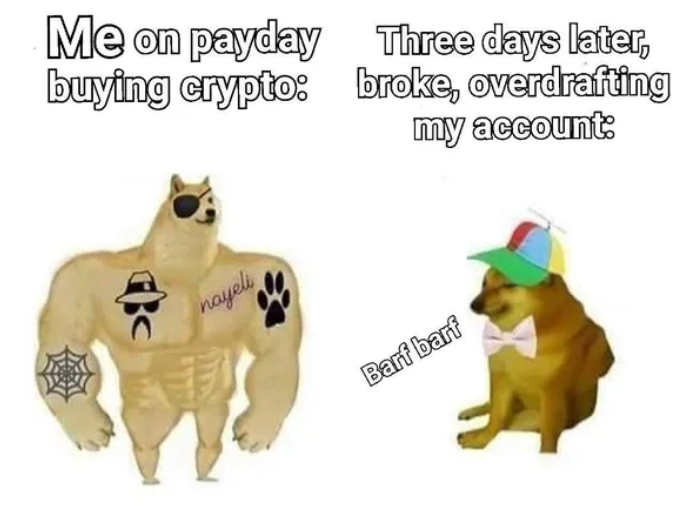
I’m broke enough af rn. I can’t afford to invest in crypto, but I really want to!!
People way smarter than you and I suggest that before you even consider investing in anything (especially crypto) you do the following:
Step 0: Reduce expenses, set budgets, set goals
Step 1: Pay rent, buy food, essentials (like toothpaste or shaving cream)
Step 2: Pay the bills (phone, internet, etc.)
Step 3: Pay health insurance/healthcare expenses
Step 4: Make payments on debts (student loan, credit card)
Step 5: Contribute to an emergency fund that’s 1–3 months worth of expenses, possibly stored in a separate account or bank
Step 6: Contribute to your MPF (if you’re in Hong Kong) or some kind of safe, long-term fund
Any investment activity has to take place after you’ve done all this for the month. If you buy crypto before toothpaste, you’ll lose all your money, be sad, and have no one to talk to because your friends left you because you have bad breath.
It’s really at step 0 you’ll find out you actually do have the money to invest. If you’re someone who buys $5 coffee every day, forgoing that and brewing it yourself frees up more than $100 per month. Forgo eating out or a night clubbing every now and then. That’s another $100. That’s already plenty to start investing with.
Shouldn’t I… you know, invest in normal stocks?
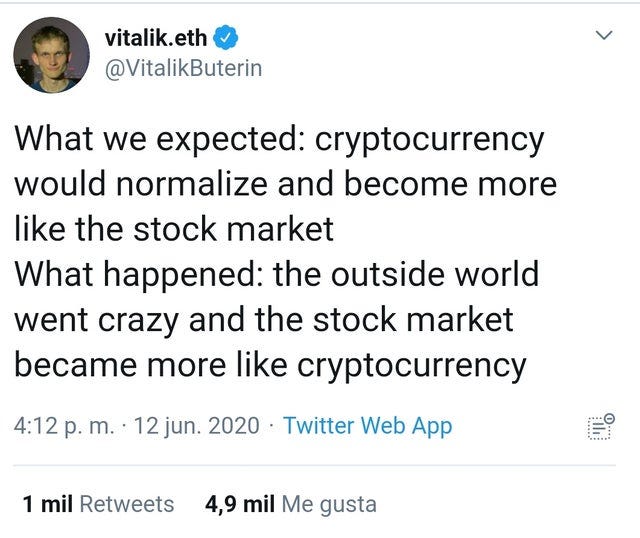
Nothing wrong with having crypto as your sole investment just depends on your appetite for risk. Because you’re in college it’s fine to chuck a hundred or two each month into crypto, as long as you promise yourself you’ll stop the mania once you get a job and invest in normal stocks too. If you’re in Hong Kong and have a job that pays more than 60 HKD an hour, your employer starts putting 5% in your MPF automatically. If you decide to start a crypto portfolio and a stock portfolio, even better. MPF, crypto, and stocks? Hell yeah.
Right, I know how crypto and blockchain work, I’ve got money to burn, but how the hell do I actually invest?
Before we even get to that, I want you to consider the following imperatives and take them to heart. This is your approach.
- Educate yourself about cryptocurrency exchanges, wallets, private and public keys, cold storage, hot storage (I’ll touch on this later), the logistics.
- Assume everything is a scam and suspicious until proven otherwise.
- If you don’t understand something, don’t invest until you do.
- Do your own research, take nothing at face value.
- Always test the water: invest a bit before you invest a lot.
- Stay informed on both world and finance news
- Don’t get greedy, set goals and when you reach them, cash out.
- Never FOMO into panic buying. People maxed out their credit cards to buy bitcoin at $16k, and then it crashed to under $4k. Don’t do that.
- Stay away from margin and futures trading.
- If it’s not legal in your country, don’t buy cryptocurrency.
- Be aware of tax and trading fees.
Yeah, that makes sense. I’m pumped up now. When are you gonna tell me how to buy crypto?
This will be a little ambiguous. Stick with it though. I’ll talk about specific exchanges and wallets right after.
Step 0: You have money (‘fiat’) in your bank account you’re ready to invest.
Step 1: You wire transfer the money to a “fiat-to-crypto” exchange
Step 2: You place a buy order and purchase a cryptocurrency (e.g. bitcoin, ethereum) on the exchange.
Step 3: You can now keep your crypto on the exchange, transfer it to your own wallet, or transfer it to a ‘crypto-to-crypto’ exchange (this type of exchange offers trading for more cryptocurrencies than a fiat-to-crypto exchange).
Step 4: If you transfer to a crypto-to-crypto exchange, you trade your initially purchased crypto for another crypto.
Step 5: You can keep your crypto on the exchange, or transfer it to your wallet
Fees are taken at each step (transfer, deposit, trading) and the process is very similar to conventional stock trading. Make sure the exchange you’re using accepts transfers from your country without your bank charging horrendous international transfer fees.
You also might need to pay tax on your capital gains. AFAIK in HK, you don’t. Elsewhere, idk. Don’t overlook this though. And don’t take my word for it. DYOR.
Shit. That seems complicated. Why does it have to be so hard? And how the hell do I get my money back out?
It’s not. Go through the motions a few times and you’ll see it makes sense and is actually pretty convenient.
To cash out, you transfer your crypto to your fiat-to-crypto exchange, trade it for fiat, and transfer out to your bank account.
Still seems kinda hard tho
The popular and reputed exchanges are user-friendly and will teach you how to use their platform.
Which exchange should I use then? Is there any verification involved?
There are hundreds of exchanges you can use, but obviously use the ones that are most popular and secure. Outside the US, popular choices include Binance (crypto-to-crypto) and Kraken (fiat-to-crypto). They both have excellent tutorials and educational resources. But DYOR. Be wary that exchanges let you buy crypto with your credit card, but the fees on it are ridiculous, sometimes a couple hundred over market price. It’s definitely worth the minor inconvenience to also operate on both a fiat-crypto and a crypto-crypto exchange if you’re going to be trading on the latter.
Your exchange will most likely conduct KYC on you. But be careful, don’t give your personal details to just any exchange.
But they’re exchanges, legal entities, what could possibly go wrong?
Last year I opened an account on an obscure exchange based in Israel and Estonia that a friend told me about. I put maybe $100 into it (felt like and still feels like a lot of money lmao) to buy a certain altcoin that friend had mentioned. I did the KYC, made the transaction, and left the crypto on that exchange. Couple of months later, I got a notification for a transaction I hadn’t made: the exchange had a bug that was maliciously exploited. A year later, I found out they went bankrupt, sold their business and my crypto, and I’d lost that money, and possibly my data. At worst, I had exposure to fraud, identity theft, and I really should have been more careful.
So I should be careful with exchanges, only use popular and reputed ones. What’s my wallet? And I’m going to put my crypto there?
Your ‘wallet’ is a blockchain address where you store your cryptocurrency. It has private keys that give access to your account, which ONLY YOU should have access to, and public keys, which you give out to receive money from people or exchanges. Private keys can be a random sequence of letters and numbers or a series of words that only you should have access to. Should you lose your device, this private key will help you regain access to your crypto. A good mobile wallet to use is Trust Wallet. But don’t take my word for it, DYOR.
There are also offline wallets, ‘cold storage’, USB sticks that keep your private keys (and thus your crypto) on a physical offline device. They are more secure, but a little pricey. The most popular one is Ledger.
What happens if I put my crypto in my wallet and then lose my private keys?
Anyone with your private keys can access your money. If you lose your keys you lose your wallet. Write them down on paper, and put them in a safe place.
Do I need a wallet? Can’t I just leave my money on my exchange?
You can choose to leave your crypto on the exchange on which you bought it. This isn’t normally an issue with Binance or Kraken for example, but they have been hacked and had money stolen in the past. Also, if it’s not in your wallet you don’t own it. Not your keys, not your crypto. Any time you want to spend your crypto, you’ll need a wallet. If you want to store it for some time, it’s advisable to use your own wallet, not your exchange.
Got it. What should I actually invest in though? What’s my game plan?
As a college student, you’re probably not looking to day trade, but instead to hold medium to long term positions on your investments. This is your strategy: Holding.
What if I decide to hold a cryptocurrency and it reaches an insane high? Do I still hold?
If there’s an enormous spike in the value of your crypto, you may want to trade it for fiat or a ‘stablecoin’ (a cryptocurrency pegged 1:1 to a fiat currency, like the US dollar) and let it sit in your account. When it goes down again, buy back what you sold and keep the profit. Doing this too often is risky though because more often than not you’ll get it wrong.
Okay, I can spare a little bit each month and I’m going to invest it in crypto. Should I wait until I have enough to buy one whole bitcoin or ethereum or something else?
If you can only spare $100 each month, don’t wait until you’ve accumulated what you think is ‘enough’ to buy crypto. Like stocks, you can buy fractions, and many cryptocurrencies are closer to $0 than to $100 (analogous to ‘penny stocks’). Just start buying on a monthly basis, irrespective of the price (but try to avoid buying on short-lived peaks if you can). This is called ‘Dollar Cost Averaging’ and it shields you a little bit from volatility, and makes sure that over time the average price you’ve bought at is fair. You can do the same when you cash out: sell over a period of time if you think it will give you a better price.
Okay, nice. How do I actually track my investments and see how I’m doing?
You’ll want to use apps like Delta or Blockfolio to log your trades. They track your overall performance, let you set price alerts, give you the news for stuff in your portfolio, and more. Pretty nifty.
I’m really smart! I watched a live youtube seminar on day trading crypto! I’m gonna make so much money!
Before we move on to choosing what to invest in, a word on day trading: Don’t.
Leave it to the professionals. The probability you’ll make money day-to-day on multiple trades aggregated over time is tiny. It’s gambling. I’ve spent quite some time learning TA with candlesticks, and beyond helping you confirm the obvious or building intuition or analysing the past and present, it’s useless. Other people will tell you otherwise, but hey, DYOR.
Got the game plan, but you’re really making me ask twice… What do I actually invest in? What crypto should I buy??
Simple answer? DYOR. Starting by examining the top 20 cryptocurrencies in terms of market capitalisation (market cap: ‘out of the total money in the market, how much of it is in this coin’) is probably a good idea. Coinmarketcap.com is the authority on market statistics. Also, look at the people involved, the team behind the cryptocurrency, their past, what they’ve worked on, how it’s doing, partnerships with corporations, governments, marketing, public opinion, planned milestones, current work, and way more.

Sounds like a ton of work. I’ll just stick with the top 5, or just Bitcoin and Ethereum then.
Picking up a chunk of bitcoin is probably a good idea. Bitcoin is the daddy of all cryptocurrencies and viewed as safer than the others (‘altcoins’). ‘BTC Dominance’ is an important metric, It tells you how much of the market is held in bitcoins. If something is used to measure the market with, it’s likely a good idea to own some. Ethereum’s neat too. But don’t be discouraged from trading altcoins, there’s some good stuff out there.
Try to find the cryptocurrencies that are well-backed, have genuine use cases, and that you believe have a future. You’ll find cryptocurrencies with use cases that really surprise you in the best way, and as long as you stick to moderate/high market cap investments, you’ll probably do okay.
So I’ll buy…. everything?
Don’t spread yourself too thin. Pick a handful of cryptocurrencies and stick to them. There are more than 2000 cryptocurrencies on the market. To start out, pick 3–6. How much you invest in each is up to you. Consider constructing your portfolio in terms of risk, with low, moderate, and high-risk investments each comprising a certain percentage which you can decide (‘low risk’ in a crypto context; crypto itself is a high-risk investment).
Just to throw a few names out there besides Ethereum and Bitcoin, you can choose to read up on Stellar, IOTA, Ripple, Cardano, Monero, VeChain, Dash, Basic Attention Token, Nano, and Binance Coin. There’s nothing significant about these coins, in particular, I just scrolled through coinmarketcap and picked out random names. If you don’t get it by now, seriously, DYOR!
Alright! I’ll do my own research and read up. But where do I start?
For information and research, you can try coindesk, Cointelegraph, Investopedia, Reddit, WSJ, etc. I’m just naming names. DYOR, even about where to DYOR. There are some incredible resources and guides way more in-depth than this one, on how to construct a portfolio, diversify, manage risk, and more. r/CryptoCurrency’s top educational posts are worth a mention too.
So what happens after I do all that?
You now own cryptocurrency which you keep in your exchange, mobile wallet, or cold storage. You track your portfolio on your phone and read up on your medium-long term investments every now and then. Every month you take a little money, buy a little crypto, log it on your portfolio app. Very infrequently you sell, when there are huge peaks or things really go bust (like you find out you accidentally invested in a scam). But for the most part, you hold through the bumps. You’ll make some terrible decisions, adjust, and learn. You might also start investing in the conventional stock market, to not put all your eggs in one basket. It’s a lot easier than with crypto.
Do this for long enough, gain experience, make money, buy a Lambo. Simple enough?
https://twitter.com/thecapital_io
A no-bullshit rundown of investing in crypto as a broke college student was originally published in The Capital on Medium, where people are continuing the conversation by highlighting and responding to this story.
from The Capital - Medium https://ift.tt/3esxDVD


0 Comments