By Ceegix on The Capital
Keynesian or John Maynard Keynes economics taught in colleges, schools, and universities, is officially dead theory, but it is still incredibly applied and taught. In the following paragraphs, I will tell you why I consider it dead theory and the Bitcoin factor behind my position.
The state seeks to apply progressive taxes, control and regulates trade, politicians continue to appeal to basic Keynesian notions to justify their interventionist plans by increasing bureaucracy, for Keynesian economists the work of the state is fundamental to the economy and its justification is the idea of a balance of consumption and investment is totally insane. We have the evil control of prices, the levels of consumer activities that they believe to be investment, more investment generates more income, which finances more consumption; more consumption stimulates more investment … This theory is not only harmful to an emerging economy in general; but also for those who save.
There are several mechanisms for these Keynesian ideas, taxes, inflation, and public spending. The fiscal and monetary authorities were ready to act whenever the total real or measured production of the economy, which was supposed to reflect the demand side of the markets, is below its potential or ideal production, which in an economy healthy should be estimated from the supply side basis. Lowering taxes would allow consumers and investors to spend more; public spending would be added directly to the total; printing or borrowing money would facilitate the opposite movements in public revenues and expenses. All orchestrated by expansive monetary policies, such as throwing a life preserver from a shipwrecked person, which is the state. And do not be fooled, the state is nothing without taxes and still manages to destroy people’s savings by printing paper money.
This impression is and was the instrument of the greatest monetary crimes in history, it is the reason why Satoshi Nakamoto invented Bitcoin in the first place, it is a tool allowed by all the central banks of the world to create liquidity and facilitate debt. In other words, inflation, reduce the value of the currency as much as possible. Insane.
Look at the value of the dollar historically:
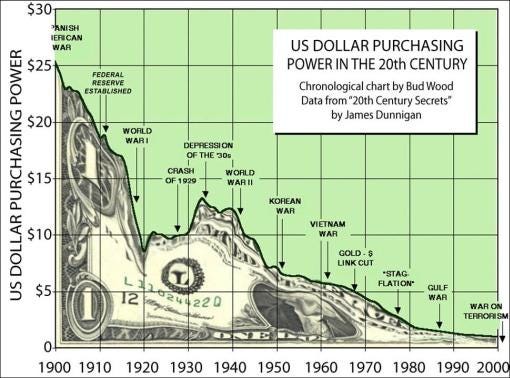
Its purchasing value has been declining for decades and even Reagan’s liberal policies could not prevent subsequent governments from continuing to murder the dollar. The “Gold Standard” could not be maintained as predicted in the 1940s, instead of being a backup for the dollar, gold was used as a safe haven by central banks, they even declared it a state resource, where it was prohibited owning it and it had to be exchanged for paper money or a criminal fine would be applied. (Roosevelt’s Gold Confiscation in 1933)
But this time, the people, in this case, Satoshi Nakamoto, managed to develop a technological way of monetization and value transfer without the need for government. A dream for any libertarian … Well, even Friedrich August von Hayek predicted it:
“I don’t think we are going to have a good coin again, before we take the matter out of the hands of the government. We cannot violently take the matter out of their hands. All we can do is slyly introduce something that they can’t stop.” Friedrich August von Hayek (1984)
And he was not the only one, Friedman longed for a technological mechanism, perhaps anticipating the rise of the internet but in a decentralized way to send and receive value or money.
Friedman passed away before bitcoin’s arrival, but he lived long enough to see the meteoric rise of the Internet throughout the 1990s. In 1999, he realized that the Internet would shape authority (Interview):
“I think the Internet will be one of the main forces to reduce the role of the government.” Milton Friedman (1999)
Friedman was always against “collectivism,” a term he used for a government that had become broad and totalitarian.
Fortunately, authoritarian regimes now have to deal with a new digital threat: decentralization.
Bitcoin has been praised as one of the technical innovations of its time. But he has to overcome an image problem, a common perception that is obscure and lawless, largely created by the stream of tabloid media reports.
Many people now believe that cryptocurrencies are simply a route of criminality, such as drug trafficking or illicit money laundering, and it is not so, criminals saw bitcoin as a way of not being tracked with large amounts of money or having problems with transaction, but this is only one of its qualities and not very important.
The greatest quality will always be its scarcity (there will only be 21 million Bitcoins) and the non-violation of Mises’ monetary regression theory as monetary value. This is for the same characteristic of being totally decentralized, that is, nobody can control or modify it and it is governed for the same reason as any asset, demand.
The adoption of Bitcoin was very fast, since with only 12 years of life it became the most profitable asset of the decade and not only increased its value by 9,000,000% but also allowed the world to come out of global monetary oppression, of course. , there are other cryptocurrencies based on the same technology with which Bitcoin (Blockchain) was born, but they will not be able to match their impact and security, not for now, the market is totally dominated by Bitcoin and there are no changes in the near future.
When reading the Paper with which Bitcoin was created (https://bitcoin.org/bitcoin.pdf) I have no doubt that the main reason for its creation was to give people the power to decide back, the right over their savings and give the world a lesson in freedom.
Keynesianism hates freedom and savings. It is for this reason that you will not see or hear anything good from Keynesian economists when talking about bitcoin or some cryptocurrency, this is the logical and expected thing, it will not surprise you to know that all the reasons they will give are because the adoption of decentralized cryptocurrencies as Bitcoin would be the death of the central reserve bank, the evil mechanism of Keynesianism itself. This is happening now, where the world’s central banks print in their quest to resurrect the economy from a forced quarantine so as not to break the public health system, a fatal error that will cost millions of people savings. And that the rise of gold, silver, and bitcoin as safe havens is accompanied by people’s mistrust of the central bank’s fiat system. And this is why I call Keynesianism the dead theory.
Stay Safe.
Ceegix - Christian Galíndez Beltrán
https://twitter.com/thecapital_io
Bitcoin and the death of Keynesianism was originally published in The Capital on Medium, where people are continuing the conversation by highlighting and responding to this story.
from The Capital - Medium https://ift.tt/3gB7UeT


0 Comments