Trust Essentials
Prerequisites:-
Decentralized Systems
In a decentralized system, there is no authority to check your credentials and certifying that you are trustworthy. Trust in a decentralized blockchain is also about securing, validating, verifying, and making sure resources needed for transaction execution are available. This is accomplished by
- Securing the chain using specific protocols.
- Validating the transaction and blocks for tamper-proofing.
- Executing and confirming the transaction.
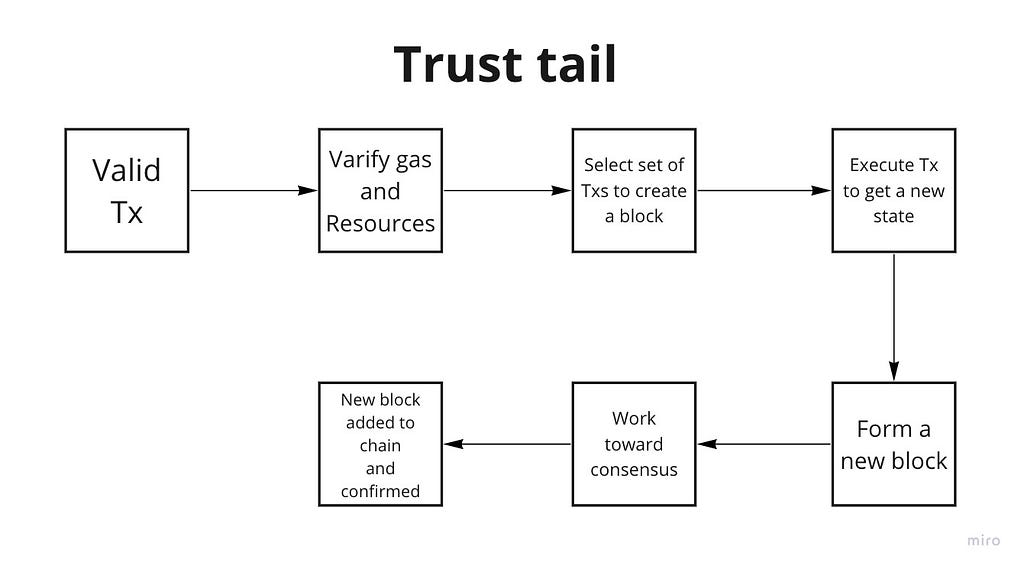
Step 1 and 2 are validated transactions and check resources. In the case of Bitcoin, there are about 20 criteria that have to be checked before a transaction is validating. Similarly, in the case of Ethereum transaction syntax, transaction signature, timestamp, nonce, gas limit, and sender account balance are validated before execution. The fuel or gas points and other resources available for smart contract execution are also validated. Transaction signature and hash are also verified.
Step 3 is executed transaction, Merkle tree hash of the validated transactions are computed. This is the transaction root of the block header. All miners execute the transaction for Ether transfer as well as for the execution of smart contracts. The state resulting from transaction execution is used in computing the Merkle tree hash of the states, the state root of the block header.
The receipt root of the block header is also computed.
Consensus Protocol
A secure chain is a single main chain with a consistent state. Every valid block added to this chain, adds to the trust level of the chain. The miners are vying and competing to add their block to the chain. Each of the candidate blocks is by a competing miner.
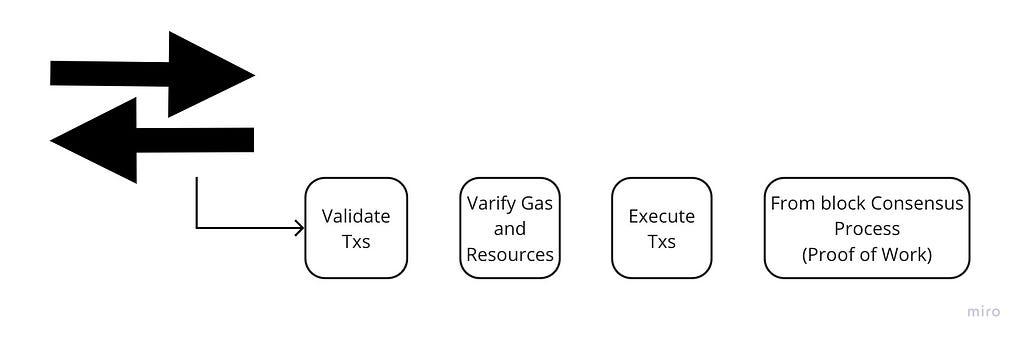
Protocol to choose the next block is called Proof of Work. It uses hashing.
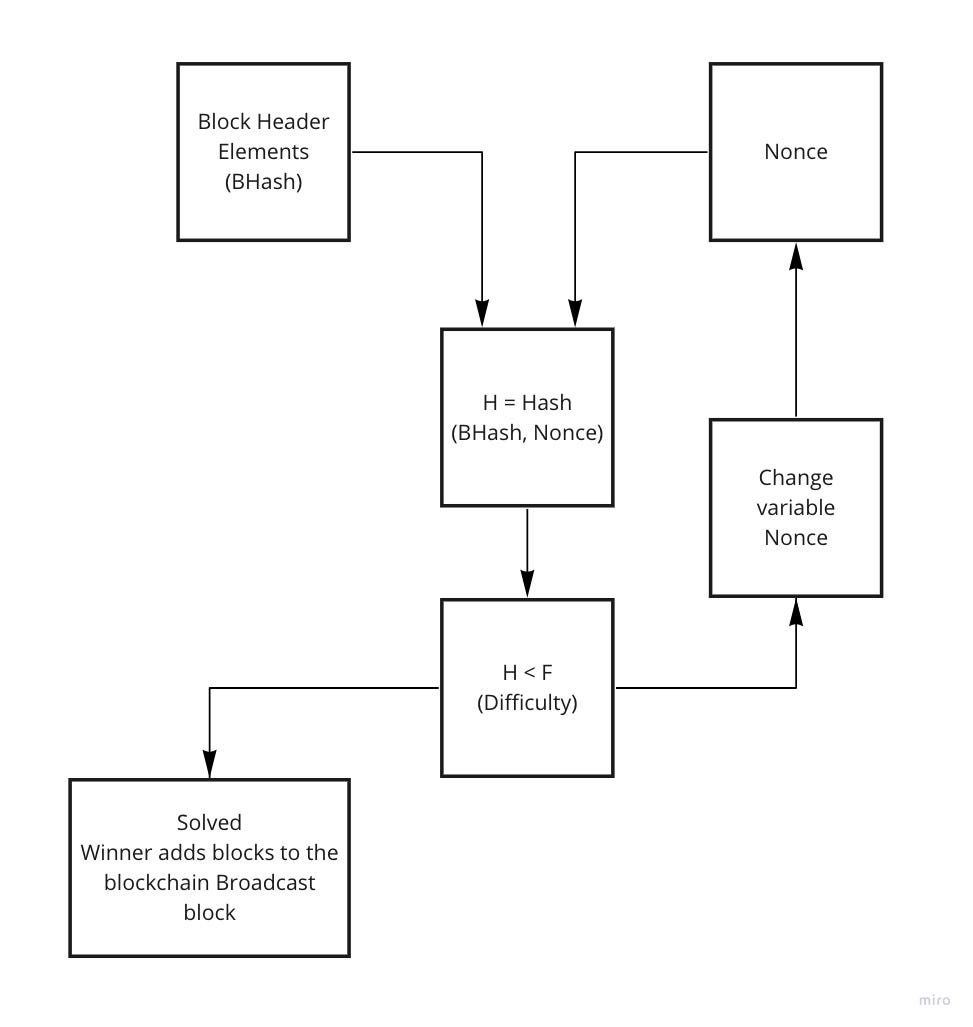
First, compute the hash of the block header elements which is a fixed value, and a nonce that is a variable. If the hash value is less than for Bitcoin and less than a function of difficulty for Ethereum, the puzzle has been solved. It hasn’t been solved, repeat the process after changing the nonce value. If the puzzle has been solved, broadcast the winning block that will be verified by other miners. Non-winning nodes add the new block to the local copy of the chain and move on to the next block. The winner gets an incentive for creating the block.
Proof of Work is a consensus protocol used by Bitcoin blockchain and Ethereum. The protocol may be the same, the implementations in these two blockchains are different.
Robustness
Trust is not only about executing regular operations correctly but also about managing exception satisfactory.
Robustness is the ability to satisfactorily manage exceptional situations. It’s all the more important in a decentralized autonomous network such as a blockchain where no intermediaries are mining the store.
Double-spending Problem-There is a possibility that digital currency can be intentionally or inadvertently reused in transactions.
A policy for handling transaction and double-spending in Bitcoin is to allow the first transaction that references the digital asset and reject the rest of the transaction that reference the same digital asset.
In Ethereum, a combination of account number and a global nonce is used to address the double-spending issue. Every time a transaction is initiated by an account, a global nonce is included in the transaction. After that, the nonce in the incremented transaction should be unique and verified to prevent any double use of the digital asset.
Forks
Forks are just normal processes in an evolutionary path of the nascent technology enabling a blockchain. If the robustness and trust are about managing exceptional situations, hard forks and soft forks are indeed at the front and centre.
Forks are of two types
- Soft Fork — When a minor process adjustment has to be carried out, typically by bootstrapping a new software to the already running processes, that is called a soft fork.
- Hard Fork — It implies a major change in the protocol of the blockchain process.
Note:- After a hard fork, the emerging two chains are incompatible.
There was an unplanned hard fork in the Ethereum protocol. Ethereum core and Ethereum classic split that was enacted to address a critical software issue is a decentralized autonomous application(DAO) that resulted in around 150 million dollar heist.
Soft fork and Hard fork in the Blockchain world are like the release of software patches and new versions of software respectively.
Forks are mechanisms that add to the robustness of the Blockchain framework. Well-managed forks help build credibility in the blockchain by providing approaches to manage unexpected faults and planned improvements.
References
- Blockchain-Based Trust & Authentication For Decentralized Sensor Networks
- How the Blockchain will Radically Transform the Economy
- A (Short) Guide to Blockchain Consensus Protocols
- Review of blockchain consensus mechanisms
- Blockchain Expert Explains One Concept in 5 Levels of Difficulty | WIRED
- How The Blockchain Is Redefining Trust
- Have Blockchain Forks Shown Hayek to be Right or Wrong?
- Split on Forks? Blockchain Leaders Learn Tough Lessons from Bitcoin Scaling
https://twitter.com/thecapital_io
Blockchain Basics(Part-4) was originally published in The Capital on Medium, where people are continuing the conversation by highlighting and responding to this story.
from The Capital - Medium https://ift.tt/3j1aNaY


0 Comments