By FVP Trade on The Capital
How to Invest During a Recession Talking Points:
- A recession is regularly joined by falling stock values, yet equities are not the most important thing in the world for recession strategies.
- To be fair, certain segments of the financial markets can still improve in value in a recession.
- Be that as it may, the currency and commodity markets can make positive returns and give diversification as the economy sees a slowdown amid increased risks.
- What is a Recession? Signs, Causes, and Impacts on Investors.
As the current worldwide growth viewpoint turns out to be increasingly unsure, brokers and investors have raised worries over the chance of an approaching recession — a troubling possibility for worldwide markets. Technically characterized as two progressive quarters of negative GDP growth, a recession is a period when the economic contract and business profits fall. Subsequently, stock valuations are periodically adjusted lower, and delivering a positive return in an equity-heavy portfolio becomes an ordeal.
What are Some of the go-to Investments During a Recession?
1. Equity Stocks to Watch During a Recession.
Under expansionary conditions, stocks that have solid growth possibilities for the future regularly command a greater valuation and produce exceptional yields as investors bank on the organization’s capacity to create more income as time advances. This circumstance typically brings about a significantly high price to earnings (P/E) ratio like those seen now in market-leading tech stocks. In case of an economic downturn, these profit-hopeful stocks are frequently disposed of as investors align their income presumptions to easing back growth and lower consumer spending.
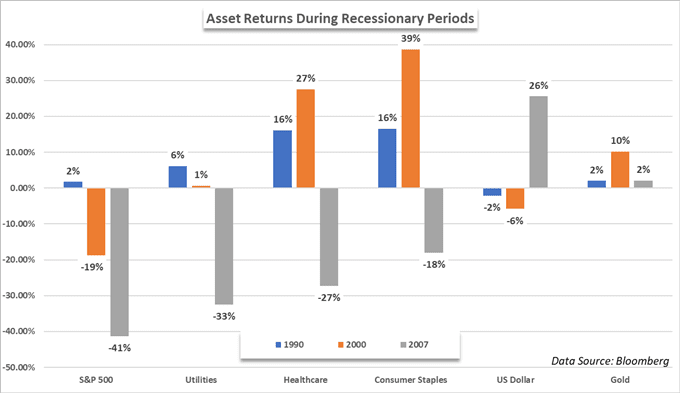
“Recessionary periods” are defined as a significant decline in economic activity across 5 key indicators — real gross domestic product, income, employment, manufacturing, and retail sales, and lasting more than a few months.
Then again, stocks with stable yet regularly and more humble income generation tend to be more protected from dramatic stock market shocks that often come with recessionary periods. These stocks are known as “defensives” and, widely speaking, including the utility, healthcare, and consumer staple sectors. Given their profitability profiles, they become a significant assortment of stocks to watch out for when the more extensive market experiences a difficult time.
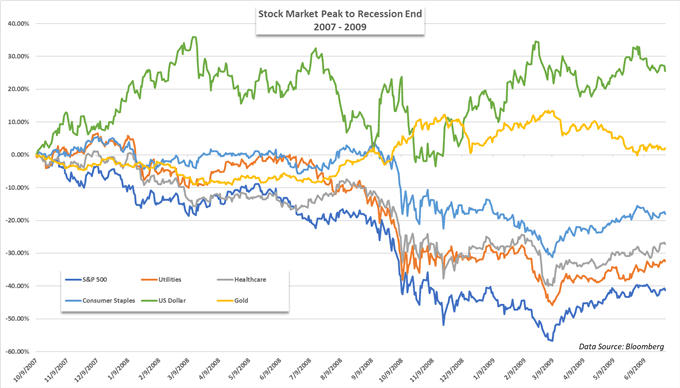
All things considered, defensive-natured equities share a positive relationship with the more extensive S&P 500, Dow Jones, and Nasdaq 100, which implies if the general market fall, they also should fall — only not as far.
Stock Market Forecast as Recession Likely Unavoidable Amid Virus Fallout.
Therefore, a portfolio entirely of equities is astoundingly powerless in the midst of a recession, especially at the beginning when losses are regularly the steepest. In light of that, it might demonstrate beneficial to look outside of the equity market for better recession-proof investments.
2. Gold is an Attractive Asset During Recessions.
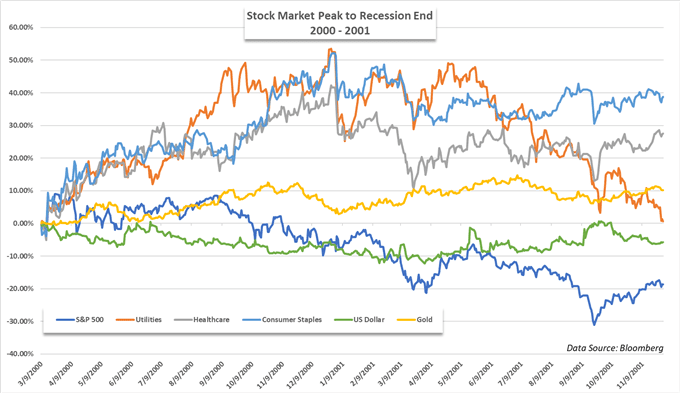
Keeping that in mind, we move our concentration to the commodity market and more explicitly, gold. XAU/USD is broadly viewed as a safe haven asset for its steady value and physicality. Furthermore, gold can also act as inflationary support, making it an appealing investment in the midst of a recession and in times of lower interest rates when inflation can take hold.
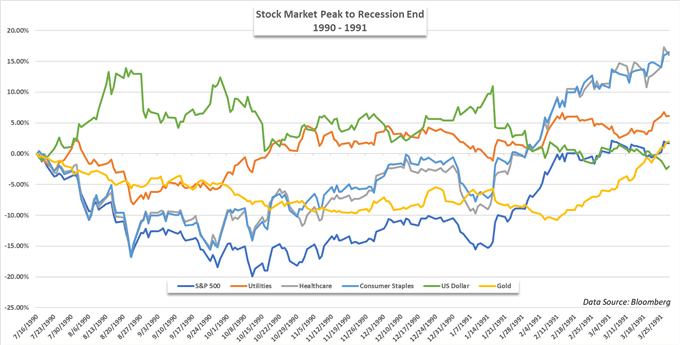
As showed in the diagrams above, gold has exhibited a practically intrinsic capacity to hold its value during contractionary periods subsequently making it an appealing investment in the midst of vulnerability.
3. USD is an Attractive Currency During Recessions.
Imparting likenesses to gold, the USD likewise is seen as a safe haven asset with similar traits. Because of its job as the world’s reserve currency and with the support of the world’s biggest economy, the USD is both unbelievably fluid and sought after. Issued by the Federal Reserve, the USD is seemingly the most secure currency on the planet and has become quasi-currency for trade-in numerous countries where their own currency have had their buying influence fall because of inflationary pressures or other financial troubles.
Thus, holding USD during times of vulnerability or unrest is frequently seen as an alluring option in contrast to other assets. Confirmed by the Great Financial Crisis when the United States hauled the remainder of the world into a worldwide recession, the US Dollar rose almost 25% from 2007 to 2009 even though the Federal Reserve brought interest rates to an all-time low.
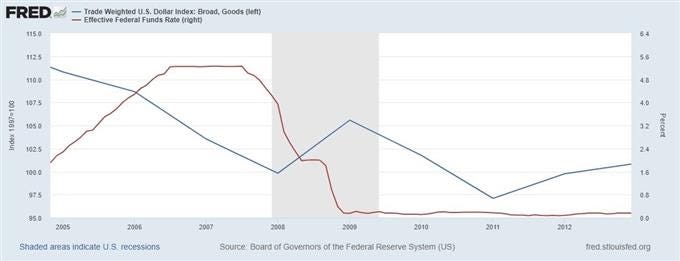
The Dollar’s strength was to a great extent owed to the way that the Federal Reserve had adequate liquidity and the US economy was soon in a situation to recover while others were embroiled in the recession, some of which have never completely recovered.
Recession Investments Conclusion.
With the advantage of knowing the past and the lesson of the three latest recessions, it very well may be contended the best recession investments are not stocks by any stretch of the imagination, but instead are assets that hold their value even as growth falls. In this manner, if equity exposure is an absolute necessity to have in your portfolio, then the USD and gold ought to be given thought, especially for the risk cautious investor or one who speculates an approaching recession.
Other Currencies to Consider Adding to Your Portfolio During a Recession are:
- Japanese Yen
- Swiss Franc

- FVP Trade | The World's Fastest Growing CFD Broker
- FVP Holdings - Your Long Term Capital Appreciation Partner
- FVP Trade
https://twitter.com/thecapital_io
Investments and Strategies During a Recession was originally published in The Capital on Medium, where people are continuing the conversation by highlighting and responding to this story.
from The Capital - Medium https://ift.tt/3hAUsIH


0 Comments