By Sagar Kafle on The Capital
After the first world war (28 July 1914 to 11 November 1918), the world economy had seen major technological change and growth. Consumer spending was soaring during the period, which was mainly due to the decreasing unemployment rate (11.7% in 1921, 6.7 % in 1922, and 2.4 % in 1923) and the availability of cheaper credit. The demand for electronic items was off the roof, as a result, most of the firm’s established mass production facility. The government started providing cheaper and easily accessible credit which benefited the majority of businesses. The economy was on the boom during the period (1920–1928), so the period is also known as “Roaring Twenties.” After the 1929 economy slows down and the global depression was daunting the world. Who would have thought that the flourishing decade could end up being the worst nightmare in the history of mankind? Let’s go through the causes of this Great Depression:
1. Speculative Investing and Stock Market Crash:
The stock market has always been a major indicator of the economy.The majority believe that substantial decrease in stock price reflects an upcoming recession and substantial increase in stock price indicate economic growth.
During the 1920s people were speculating in stocks without proper research as a result stock market was making new highs every day.
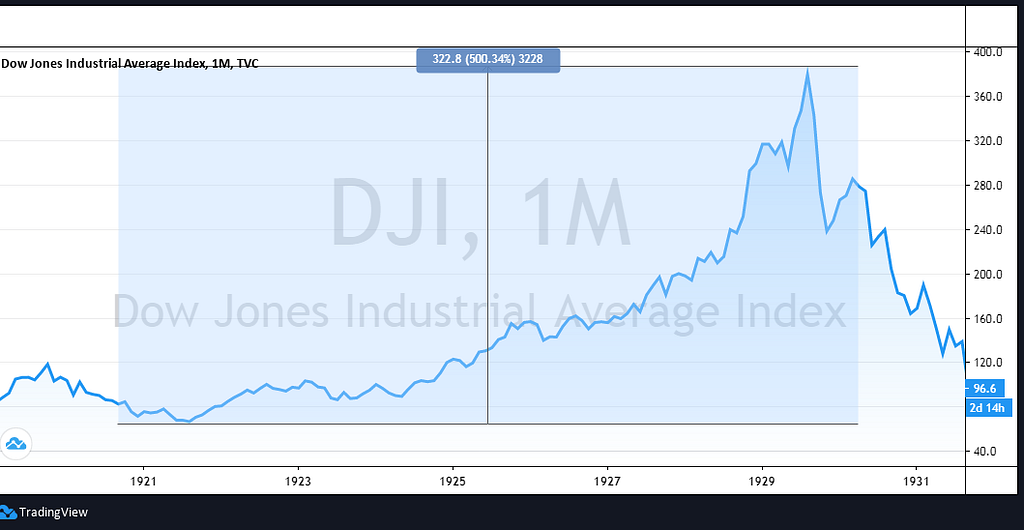
DJI( Dow Jones Industrial Average ), is the overall stock market index of the USA.
DJI index progressed from almost 63 in August 1921 to approximately 387 in September 1929 which is almost 500% increase in the span of 8 years, averaging almost 63% rise every year. Stocks of fundamentally weak companies also saw massive growth. The stock price of most companies was not reflective of the earning.
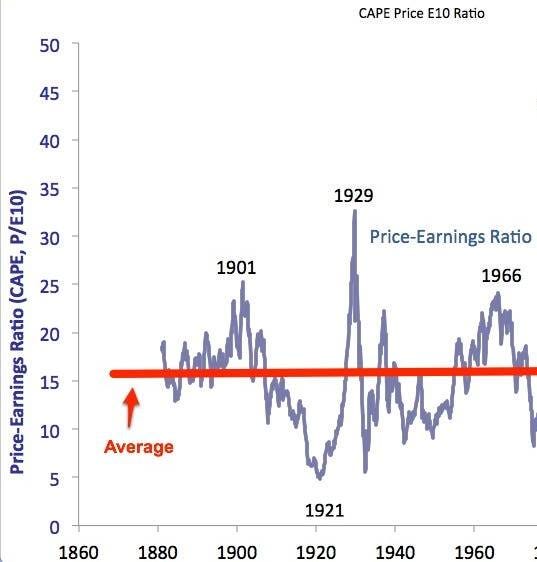
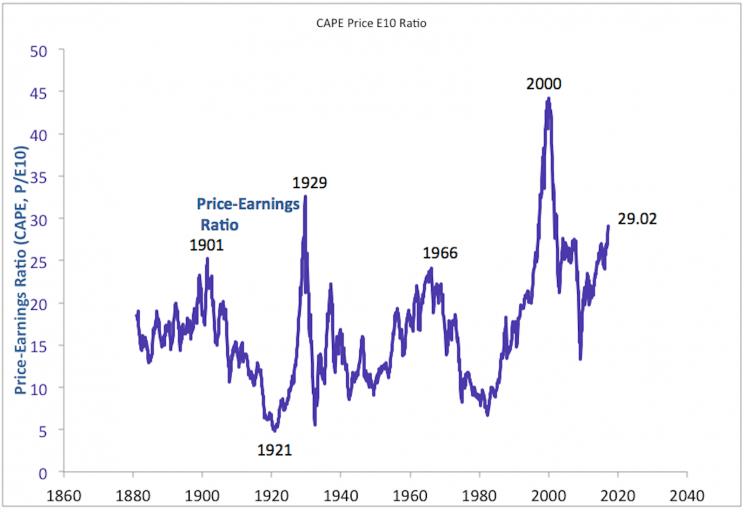
The price-to-earnings ratio (P/E ratio) is the ratio for valuing a company that measures its current share price relative to its earning per share.
Generally higher PE represents overvaluation of company and vice versa. The PE of DJI was almost in the range of 33 in 1929, which is almost twice the average PE of 16.DJI crossed PE of 31 only twice i.e.in (2001 dot-com crash and in 1929:the Great Depression).
The future was looking prosperous until 1929 when the economy began to slow down. The stock market started to fall in October 1929. DJI crashed 12% on October 29, 1929, also known as black Tuesday. People stopped investing and started liquidating stocks. Also, the demand for consumer goods and electrical items started to fall. Industrial production of the US felt almost half within a few years. It was well reflected in the share price of the company. The stock market fell from almost 387 to low of 40.56 eroding almost 90% wealth till 1933. The Majority of people lost their life savings. Economists believe that the stock market crash triggered the beginning of ‘The Great Depression’.
2.Banks Failure
Banks grant loans to most of the businesses and institutions regardless of credit history during the period 1920–1928. Also, the newly formed Fed reduced credit to core capital plus deposit ratio(CCD ratio), which also increased the risk for the bank failures. The banks faced unbearable liquidity crisis because of depositors withdrawing savings as majority of them lost jobs.
Banks weren’t able to recover loans. It was really hard for them to continue operations. In 1929 around 650 banks failed, approximately 1300 failed in 1930, and till 1933 upwards of 8000 banks filed for bankruptcy.
Depositors lost almost $140 billion during the period. Public lost faith in the banking system and government.
3. Deflation and rising interest rates:
A general increase in prices and fall in the purchasing value of money is inflation.
Generally, higher inflation is accompanied by strong economic growth. If Aggregate Demand (AD) in an economy expands faster than aggregate supply, we would expect to see a higher inflation rate. The inflation rate of around 4% is considered sound for a growing economy.
Negative inflation is deflation. Deflation occurs when aggregate supply is higher than aggregate demand and also due to a shortage of money in circulation. Deflation is considered a sign of a weak and stagnant economy.
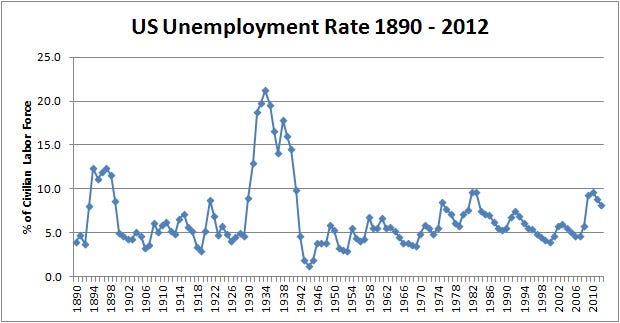
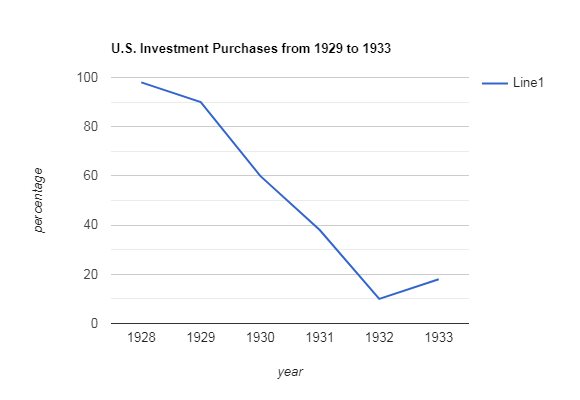
The unemployment rate was rising. By 1933 almost 25% of the Americans lost their jobs which were the main reason for the reduction in investment purchases by the general public. US investment Purchase index felt from almost 90 to around 10 from 1929 to 1932. As a result, many firms discontinue production, thus increasing job layoffs and unemployment. The vicious cycle began.
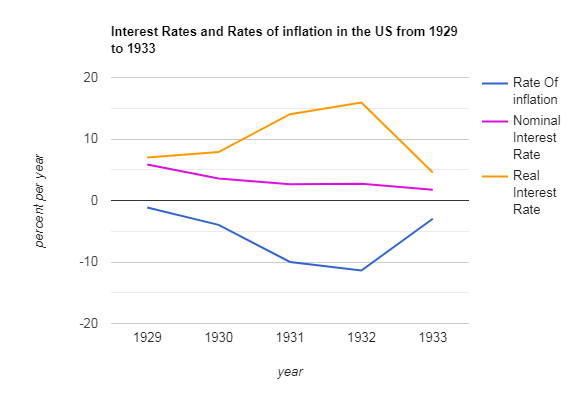
The above diagram shows the nominal interest rate( interest rate without considering inflation) was decreasing and the real interest rate ( interest rate after considering inflation) was increasing. It was expensive for the business and general public to borrow funds, in turn decreasing the money supply.
Deflation and high real interest rate have a negative impact on investment.
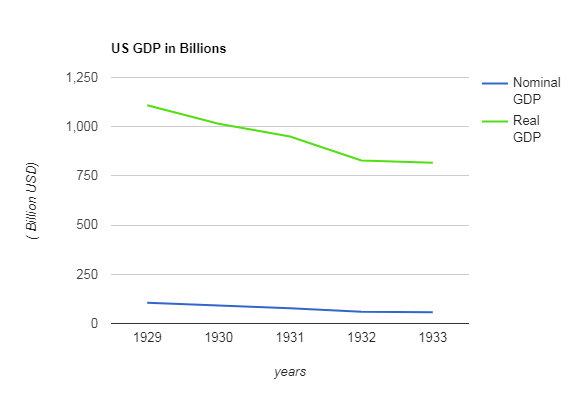
The above line graph shows the contraction in the GDP of America. Real GDP of the USA shrank from $1109 Billion in 1929 to $817 Billion in 1933 which was a depletion of almost 25%.
High real interest rate due to deflation was a major reason behind the sharp decline in investment and is considered the utmost cause of The Great Depression.
4. Smoot-Hawley Tariff Act
In 1929, Congress introduced the Smoot-Hawley Tariff Act which became official law in 1930. This law imposed a high tariff on almost 20000 imported goods (averaging 20% on wide range of agricultural and industrial products). The major economies also imposed tariffs to counter the act which reduced global trade. It is considered a major cause of the global spread of depression.
5. Lack of intervention by FED
The Central bank of USA(Federal Reserve) which was established in Dec. 23 1913 has done nothing to save a sinking economy. They remained on the sideline and observed the biggest economic downfall. Fed should have played an important role to save the economy. On the contrary, the Fed increased interest rate which accelerates the catastrophe. The Federal Reserve didn't provide aids to banks and businesses. Some economists believe that, if the Fed intervenes to solve the money supply and interest rate, the catastrophe could have only been a recession not ‘THE GREAT DEPRESSION’.
The great depression may have multiple causes, some causes could have been prevented and some couldn't have been prevented. After the Great Depression several reforms and policies were drafted and approved which waved the path for the prosperous century.
Did you know?
Since 1857, a recession has occurred, on average, about every three-and-a-quarter years. Since World War II, there has been a recession every 58.4 months or nearly 5 years.
We can learn from the blunder of the great depression and, be well prepared for another big economic crisis.
I remember the famous quote from Eric Thomas:
“I‘ve made more money than I have ever made in my life during a recession.”
So, let's take a step towards financial freedom and take recession as an opportunity.
https://twitter.com/thecapital_io
The Great Depression Of 1929:Causes was originally published in The Capital on Medium, where people are continuing the conversation by highlighting and responding to this story.
from The Capital - Medium https://ift.tt/2ZPG8EO


0 Comments