By Grace Kolawole on The Capital

Financial firms were the early adopters of the mainframe computers, relational databases, and have eagerly awaited the next level of computational power. Inorganic Intelligence helps Financial companies in solving human problems, by increasing efficiency. Artificial Intelligence improves results by applying methods derived from aspects of Human Intelligence at a beyond-human-scale level. The computational arms race of the past 2 decades has revolutionized the FinTech companies.
FinTech is a combination of the terms “finance” and “technology” and refers to any business that uses technology to enhance or automate financial services and processes.
Initially, the word FinTech applied to the technology employed at the back-end systems of established financial institutions. Since then, however, there has been a shift to more consumer-oriented services and therefore a more consumer-oriented definition.
It is relatively new, and often a term that applies to any emerging technology that helps financial institutions to deliver financial services in a faster and newer way. Think of the difference between walking into a bank to request your balance and the ability to pull up that information in real-time on your phone and you’ll have a good idea of FinTech’s impact.
Everything from a consumer’s ability to go online and see their financial transactions to apps that allows you to pay friends to tools that allow financial institutions to make quick lending decisions are all part of the evolution of financial services.
The ability for investors to do their own research, choose stocks and see their portfolio performance in real-time is also an example of FinTech in action, with the use of technologies such as Machine Learning, Artificial Intelligence, Neural Networks, Big Data Analytics, evolutionary algorithms, and much more that allow computers to crunch huge, diverse and deep datasets than ever before.
The FinTech Industry
FinTech companies integrate technologies into traditional financial sectors to make them safer, faster, and more efficient. FinTech is one of the fastest-growing tech sectors, with companies innovating in almost every area of finance; from payments and loans to credit scoring and stock trading.
FinTech is changing the world of finance for consumers in numerous ways. For example, you can now open a bank account over the internet, without physically visiting a bank. You can link the account to your smartphone and use it to monitor your transactions. You can even turn your smartphone into a “digital wallet” and use it to pay for things using money in your account.

The use of smartphones for mobile banking, investing, loaning services, and cryptocurrency is an example of technologies aiming to make financial services more accessible to the general public.
Financial technology companies consist of both startups and established financial institutions and technology companies trying to replace or enhance the usage of financial services provided by existing financial companies.
The guts behind financial technology vary from project to project, application to application. Some of the newest advances, however, are utilizing machine learning algorithms and data science to do everything from processing credit risks to running hedge funds.
The growth of FinTech is due in large part to the opportunity it affords small players to compete on the same field as traditional financial institutions. Thanks to FinTech, it’s no longer about who is biggest, but who is fastest and most responsive at effectively addressing the ever-changing consumer demands.
FinTech is also rapidly changing the insurance and investment industries. Car insurance providers now sell “telematics-based” insurance where your driving is monitored using data collected via your smartphone or a “black box” fitted in your car. This data can then be used to determine how much you pay for your insurance policy.
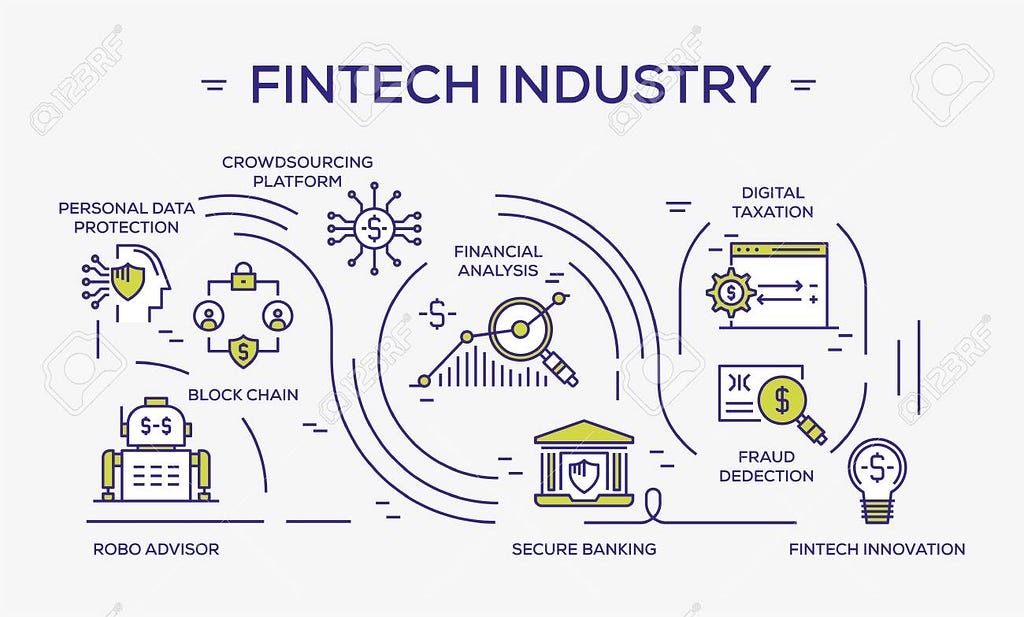
Advances in technology mean consumers can also invest over the internet on an “execution-only” basis without any face-to-face interaction. In time, you may be able to get automated financial advice or “Robo advice” with little or no human interaction.
Additionally, the solutions offered by FinTech companies are no longer “one size fits all.” Instead, they provide targeted — often nook — services that fill the gap of a particular financial need, sometimes at much lower costs than those offered by traditional financial providers.
Potential Benefits

- Speed
As the velocity of commerce is increasing, it’s very important to have a quicker means of this product. FinTech brings about online delivery and so are easier and quicker for consumers to access.
- Efficiency
Financial innovations are unlike other inventions in that they can directly impact the efficiency of the financial sector, which is how savings and investment are intermediated in an economy — and which then affect growth.
Yet FinTech is part of the digital economy that has produced innovations that have transformed the way we live, even as productivity growth has been slowing across advanced economies for decades.
- Payment
Optimizing operational efficiency is one of the aspects FinTech knows how to do. Scaling to meet the needs of consumers is what made the industry grow and go that extra mile. Providers not only guarantee payments from any device made through an online platform but for most, there is an instant execution or maximum one business day. This is already a step-up as with any bank processing times are long and costly (commissions).
- Convenience
Technology has been a constant factor towards lower costs and increasing convenience, the increased availability and use of the internet and mobile devices could offer greater convenience and access to financial services,
- Cheaper Deals
The advantage of lower premiums is given to consumers. FinTech companies may not need to invest money in a physical infrastructure so may be able to offer cheaper deals to consumers.
- More Personalized Product
There is greater access to a range of consumer information making it easier to offer more personalized products and services and to react to consumers’ individual needs.
Conclusion
FinTech is one of the fastest-growing tech sectors, with the Financial sector accounting for about 20% of the data scientists currently employed. Financial institutions are reformed through technology recognizing the relative value of data.
https://twitter.com/thecapital_io
What is FinTech? And How It reshapes Financial Services was originally published in The Capital on Medium, where people are continuing the conversation by highlighting and responding to this story.
from The Capital - Medium https://ift.tt/38VHOkc


0 Comments