We seem to have entered a new phase of greater maturity in the crypto markets where news of charges against BitMEX barely leaves a dent
Check out our new platform: https://thecapital.io/
This week in Crypto
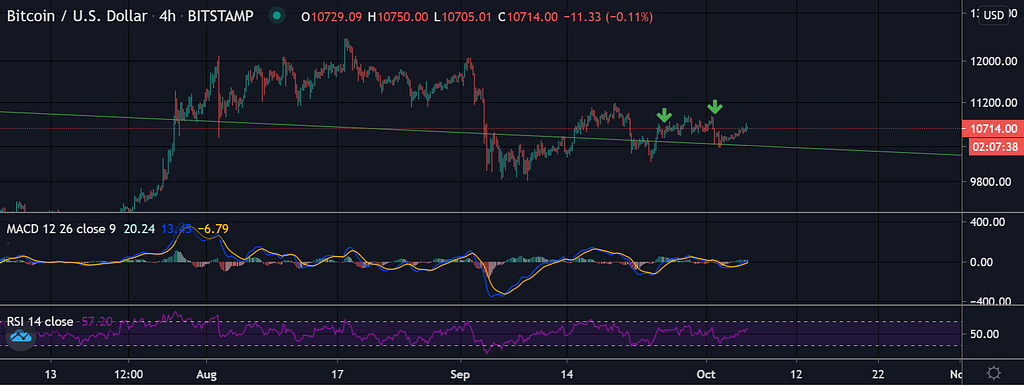
There are many periods in the past when exchange hacks and regulatory pressure from governments (the multiple China bans come to mind) would drive the price of Bitcoin and the entire crypto complex down and cause significant frustration to market participants and investors alike. We seem to have now entered a new phase of greater maturity and conviction in the crypto markets where the unquestionably recent bearish news regarding BitMEX and KuCoin the week before, has had limited impact on market price. A rather insignificant 4% drop occurred as the BitMEX news broke with BTC subsequently bouncing nicely off the descending macro trend line it broke at the end of July and has tracked along ever since. Even without the BitMEX news, this type of drop and price action at resistance is entirely expected when trading Bitcoin and really not that significant.

The Bitcoin price floor (or base) that was discussed last week and has been establishing above $10,000, now for its record 10th week, seems to be growing in strength. Investors at these price levels seem to have much longer term views that the current bearish short term legal and security issues are currently being easily absorbed by the market. If news of this nature can’t shake investors’ hands, then there is a strong case to be made that this $10,000 price floor is indeed that, a floor. The chart below highlights this well and sets a bullish tone for 2021 should this hypothesis be confirmed. The first arrow being the Kucoin hack and the second being the BitMEX charges.
BitMEX
An explosive week of news saw pioneering Bitcoin and crypto derivatives exchange, BitMEX and their founders get handed down charges by the Federal US regulatory board, the Commodity Futures Trading Commission [CFTC] for operating an unlicensed and unregistered derivatives platform. Despite the BitMEX business being registered in the ‘’regulation lite’’ jurisdiction of Seychelles, the CFTC alleges that BitMEX products and services were offered to US citizens, and as a result, must comply with US regulations.
“Digital assets hold great promise for our derivatives markets and for our economy….For the United States to be a global leader in this space, it is imperative that we root out illegal activity like that alleged in this case. New and innovative financial products can flourish only if there is market integrity. We can’t allow bad actors that break the law to gain an advantage over exchanges that are doing the right thing by complying with our rules.” Chairman Heath P. Tarbert, CFTC
While the CFTC charge is a civil action and can often result in a sizable fine and a swift change in how the accused operates so not to continue to breach the regulations, BitMEX and its founders were also charged by the Department of Justice with ‘’violating the Bank Secrecy Act and conspiring to violate the Bank Secrecy Act’’. These are criminal charges and an altogether different beast which can result in up to 5 years in prison for each alleged offense and has already resulted in the BitMEX CTO being arrested in the US last week.
BitMEX have responded strongly to refute the claims, and at the time of writing continue to provide markets for the various contracts the BitMEX exchange offers, and importantly is processing withdrawals. Important questions exist surrounding the control over the private keys of the wallets that hold client deposits and also the infamous BitMEX insurance fund which holds circa US$395mln worth of BTC. With one of the founders arrested and danger of other founders’ freedoms and movements being restricted, the risk of BitMEX users’ assets becoming locked up, frozen, or even seized remains a credible concern. As a result, outflows of Bitcoin from the exchange have accelerated, and open interest has understandably dropped as market makers and traders reduce their exposure to BitMEX as this plays out.
We will continue to follow this story as events develop, however, this most recent action by US regulators and law enforcement exposes the protectionism and acute contradictions that exist in modern global finance, which is largely policed by the US and justified by the hegemonic role that the USD has in international trade and commerce…all in the name of protecting the consumer, or so they say.
It should be noted that BitMEX have, in majority, stayed true to the ethos of what Bitcoin is. They are a Bitcoin native company and their public platform does not touch fiat banking rails. They have innovated first and maintained credible and liquid markets allowing their users to hedge risk and speculate on price moves of a variety of cryptocurrencies, as well as provide highly regarded research and analysis free and open to everyone. More recently, they have provided grants to a host of Bitcoin developers as well as various charitable donations and sponsorships. One of the accused founders, Ben Delo, has even pledged to give away his vast fortune via Bill and Melinda Gates foundation — details of which can be found here. Despite BitMEX, in our opinion, being a credible business run honestly by legitimate founders, none of this matters to US regulators and law enforcement if the company did at some point in their history provide access to their platform to US residents or entities, either knowingly or unknowingly.
Given the surprisingly hefty criminal charges laid against them, and the complete absence of similar charges for any senior officials of commercial banks (despite countless alleged violations of the Bank Secrecy Act and trillions of dollars of fines and settlements paid by these commercial banks over the past decade), we can’t help but feel that US lawmakers are intent on making an example out of BitMEX and its founders here. Let’s hope they don’t pull a ”Ross Ulbricht’’ on them.
FinCEN Files
On the 20th of September, US media company BuzzFeed published a series of leaked ~2,500 documents now dubbed “the FinCEN files.” The documents highlight Suspicious Activity Reports (SARs) that banks around the world disclosed to the US Treasury when dealing with USD transactions regardless of what jurisdiction the SAR occurred in. These types of reports are nothing unusual and are commonplace in the day-to-day activities of regulated institutions in their ongoing battle with financial crime and money laundering. However, the FinCEN files have shown the extent to which the modern financial system is under attack and exploited by criminals.
With the files, we have learned of SARs explaining HSBC’s processing of millions of USD from Ponzi schemes, further reports of JP Morgan being potentially involved in the movement of over $1bn in funds through unknown companies linked with organized criminals, and even sanctioned Russian PEPs using Barclays to move their wealth around. The files shine an uncomfortable light on the scale of the problem that the world faces.
What is important here is the sheer scale of the potential and proven money laundering that is happening within the banks despite the KYC and AML requirements they are required to carry out on client transactions. According to the UN, approximately $2 trillion (5% of global GDP) is laundered each year, the vast majority is via the banks of which ~$400bn can be linked to the illegal drug markets. Either way one looks at this, the current checks and balances to stop money laundering, including the often delayed submittance of SARs long after the event, don’t appear to be working very well.
The specific details of the failure of the SARs reporting system can be read here and make for some shocking reading. Crypto is not immune to money laundering but we do fear that overtly heavy-handed treatment of certain companies and individuals may result in unrepresentative and unproportional charges and possible sentences for certain parts of industry. It is natural for any incumbent to fight to save their seat at the table, however, in this instance, the modern system is in disarray and can hardly hold itself up to be the bastion of fair and just markets and the latest $900 million fine levied at JPM for market manipulation is a case in point. Don’t do what I do, do what I say!
Sadly for many, BitMEX may become the loser in the current battle between the old and the new.
Sign up to our free weekly newsletter at www.kenetic.capital
https://twitter.com/thecapital_io
The Seemingly Bulletproof Market was originally published in The Capital on Medium, where people are continuing the conversation by highlighting and responding to this story.
from The Capital - Medium https://ift.tt/2GnU17z


0 Comments